Expert AC Repair Home Services In Alvin
AC repair in Alvin, TX is a local service for repairing air conditioning systems. Your house is getting hot, and your AC is weak, loud, or not running at all. You want to know what’s wrong, what it should cost, and who to call.
Du-West Air Conditioning fixes home AC in Alvin. You can book an emergency or scheduled service visit.
Most AC repairs in Alvin cost $171 to $827, and the average is about $586. This page helps you match what you notice to the likely cause. It also shows you how to check a tech’s Texas license and decide whether to repair or replace.
AC Repair Core Insights
- Du-West Air Conditioning offers emergency and scheduled AC repair for homes in Alvin, TX.
- AC repair in Alvin usually costs $171 to $827, with an average of about $586.
- Common AC problems include refrigerant leaks, dirty filters, faulty capacitors, electrical issues, thermostat trouble, and duct leaks.
- Refrigerant leaks cut cooling and raise your bills. Texas requires a licensed contractor for this kind of work.
- Replace air filters every one to three months to prevent frozen coils, weak airflow, and higher energy use.
- Before anyone works on your AC, look up the company on TDLR’s online License Search.
What’s Wrong With Your AC? Common Repair Problems in Alvin Homes
Most AC problems in Alvin homes come from six causes: refrigerant leaks, dirty filters, bad capacitors, electrical faults, thermostat trouble, and leaky ducts. Your AC’s symptoms can point you toward the cause.
Use this list as a guide to possible causes, not a final diagnosis. A tech still needs to confirm what failed.
- Outdoor unit hums, but the fan won’t spin: often a bad capacitor.
- Clicking from the outdoor unit: possibly a worn contactor.
- Warm air and rising power bills: possibly a refrigerant leak.
- Ice on the coil and weak airflow: could be a clogged filter, blocked airflow, a refrigerant problem, or the evaporator coil.
- Weak airflow from the vents: possibly the blower motor.
- Some rooms hot, others cold: possibly leaky ducts.
- AC runs nonstop or won’t start: check the thermostat first.
Start with the safe checks: look at the filter and the thermostat. If you see ice, turn the system off and book service instead of letting it keep running.
Leave capacitor, refrigerant, and wiring repairs to a pro. Don’t touch the capacitor terminals, and never try to spin a stuck fan by hand.
Refrigerant Leaks: Warm Air, Hissing, and Higher Bills
Refrigerant leaks happen when AC refrigerant escapes through cracks or damaged connections. You may notice warm air from the vents and power bills that keep climbing. A hissing sound from the unit is another sign of escaping refrigerant.
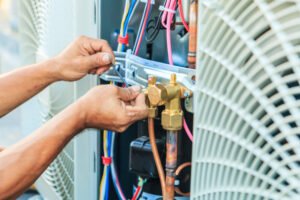
Leaks often form at the evaporator coil, the condenser coil, refrigerant line connections, and Schrader valves (small service ports on the lines). A leak forces your AC to work much harder than it should. Frozen coils can also point to a serious leak that needs a pro right away.
Many homeowners notice higher energy bills before they find the leak. Fixing it means finding the leak safely, then sealing the connection or replacing the damaged part.
Don’t try to fix a refrigerant leak yourself. DIY refrigerant work can harm your health and break environmental laws. In Texas, AC work for the public (outside a few exemptions) must go through a licensed AC contractor who carries liability insurance.
Dirty Air Filters: The Fix You Can Do Yourself
Dirty air filters are the one AC problem you can check and fix yourself before you call anyone. A clogged filter cuts the airflow through your system. That leads to uneven temperatures and makes your AC work harder and use more energy.
Clogged filters can also freeze your evaporator coil, which blocks even more airflow. You may see ice on the refrigerant lines, and the AC stops cooling well. Dirt buildup can also cause performance issues and unpleasant odors in your home.
Skipping filter changes adds wear and tear and can shorten your system’s life. Check your filter every 30 to 60 days and replace it if it looks dirty or damaged. Plan to change it every one to three months, and more often if you have pets or family members with allergies.
Faulty Capacitors: Outdoor Unit Hums but the Fan Won’t Spin
A faulty capacitor is a common reason an AC won’t start. The capacitor is a small cylinder inside your outdoor unit. It sends the electrical boost that starts your compressor and fan motors each time your system turns on.
Here’s the classic sign: your outdoor unit hums, but the fan isn’t spinning. Without a working capacitor, your AC can’t start or run the right way.
Most capacitors last 10 to 15 years under normal conditions. In Houston-area heat and humidity, they tend to wear out sooner. Age, heat, and electrical stress can all cause a capacitor to fail, and fixing it fast helps prevent further damage.
Electrical Problems: Clicking, Tripped Breakers, or No Power
Electrical problems can stop your AC completely or make it run unsafely. A clicking sound from the outdoor unit often points to the contactor. The contactor is the switch that turns the outdoor unit on and off.
Your AC might not turn on, might not cool well, or might make strange sounds because of hidden wiring trouble. Loose connections may seem minor, but they can create serious safety hazards in your home.
You can safely check whether a breaker has tripped. If it trips again after you reset it once, stop and call a pro. Wiring repairs and rewiring are not DIY jobs.
Thermostat Issues: AC Runs Nonstop or Won’t Start
Thermostat problems can make your AC run without stopping, or refuse to start at all. A faulty thermostat can also give wrong temperature readings, so your home never reaches the number on the screen.
Try a quick check before you book a visit. Replace the thermostat batteries if it uses them. Make sure it is set to “Cool” and set a few degrees below the room temperature.
If the AC still won’t respond, the thermostat may need repair or replacement. Du-West includes thermostat repair and replacement as part of its AC repair service in Alvin.
Ductwork Leaks: Some Rooms Hot, Others Cold
Ductwork leaks let cool air escape through cracks or holes before it reaches your rooms. That’s why some rooms stay cold while others feel warm. Leaky ducts also make your AC work much harder than it should.
Duct leaks can lead to an AC that blows hot air or shuts off without warning on hot Alvin days. Duct leaks are one of the most common reasons Alvin homeowners call for AC repair.
A clammy house can also point to a different problem. An oversized AC unit “short-cycles,” which means it cools the air fast but shuts off before it pulls out moisture. That leaves your home damp and can lead to mold.
How Do You Check a Texas AC License?
You can check a Texas AC license on TDLR’s online License Search. TDLR is the Texas Department of Licensing and Regulation, the state agency that licenses AC contractors.
This applies to mini-splits, too. A mini-split is a split system, so the work needs a licensed AC contractor.
- Ask the company for its full business name and TDLR license number.
- Open TDLR’s License Search and look up the Air Conditioning and Refrigeration contractor.
- Make sure the record matches the company you are hiring and the license is current. Texas AC contractor licenses are good for one year.
- Check the license class. Class A covers any size unit. Class B covers cooling systems of 25 tons or less.
- Look at TDLR’s posted Disciplinary Actions to see if the company has been in trouble.
- Ask for current proof of liability insurance. Class A needs $300,000 per occurrence and $600,000 total. Class B needs $100,000 per occurrence and $200,000 total.
A license also tells you something about experience. To apply, a contractor needs at least 48 months of hands-on AC work under a licensed contractor in the past 72 months. If you have a problem later, TDLR also has a way for consumers to file a complaint.
Why Is Unlicensed AC Work Risky?
Unlicensed AC work is risky because unlicensed contractors often have no insurance. If your system fails after the job, you may have no way to recover your money.
A former TDLR executive director, William Kuntz, put it this way: “This is a consumer safety issue. Unlicensed contractors haven’t shown that they know how to properly install or service these units.”
The state does take action. In one 2004 sting, TDLR named 25 unlicensed contractors, with possible penalties of up to $5,000 per violation.
Why Alvin Homeowners Call Du-West for AC Repair
Du-West Air Conditioning repairs home AC systems in Alvin, TX, with both emergency and scheduled visits. Here’s what to know before you book.
Is Residential AC Repair Available in Alvin, TX?
Yes, residential AC repair is available in Alvin, TX, and home AC is the focus of Du-West’s work. The team handles repair, installation, and replacement of central air conditioners and ductless mini-splits.
Regular maintenance from Du-West helps keep your AC running well and can help your equipment last longer. Catching small problems early, like a weak capacitor or a dirty filter, can help you avoid bigger repairs later.
Which Alvin Neighborhoods Does Du-West Serve?
Du-West serves homeowners in Alvin, TX. If you live in a nearby neighborhood, ask when you call to confirm your street is in the service area.
How Can You Book With Confidence?
You can book with confidence by having your AC’s symptoms, its age, and a license check ready before you call. Those three things help you judge any quote.
Write down what you’ve noticed, such as humming, clicking, warm air, or ice on the lines. Note your system’s age if you know it, so you can use the $5,000 rule with your quote.
When you book, ask for the company’s TDLR license number and look it up yourself. Texas requires AC work to go through a licensed contractor with liability insurance, so a good company will share this gladly.
If your home is getting hot and you can’t find the cause, don’t wait it out. Contact Du-West for emergency or scheduled AC repair in Alvin, TX, and get your home cool again.
AC Repair F.A.Q.’s
1. How do I know my home’s AC needs expert repair in Alvin?
Warm air from your vents, odd noises, weak airflow, or a climbing energy bill are all clear warning signs. In Alvin’s hot, humid summers, small problems can snowball fast. A quick call to a local AC repair tech can catch a minor fault before it turns into a costly breakdown.
2. What does an expert AC repair service usually include?
A trained tech checks your whole system, from the thermostat to the outdoor unit, looking for refrigerant leaks, worn parts, clogged filters, and electrical issues. They walk you through what they found before starting any work.
3. How long does a typical AC repair take?
Most home AC repairs wrap up in one to three hours, though a major part replacement can take a bit longer.
4. Is regular AC maintenance worth it for Alvin homeowners?
The U.S. Department of Energy says clean filters alone can cut your AC’s energy use by 5 to 15 percent, which adds up fast over a long Texas summer. A yearly tune-up keeps your system running efficiently and helps it last longer.